
Development of a reactor with high cycle stability for indirect hydrogen storage via the iron-steam reaction pathway (BOY-200)
In the context of the energy transition, a functioning hydrogen economy requires efficient hydrogen storage. The indirect storage of hydrogen in iron and its oxides is particularly promising for decentralized applications, as it offers high volumetric storage density, good storage stability, and the provision of high-purity hydrogen, making it an attractive alternative to technologies such as metal hydride storage, LOHCs, pressurized tanks, or hydrogen derivatives. As illustrated in Figure 1, iron oxides are reduced using green hydrogen, thereby storing chemical energy indirectly in metallic iron. When required, the iron is oxidized with steam, releasing hydrogen while simultaneously providing heat.
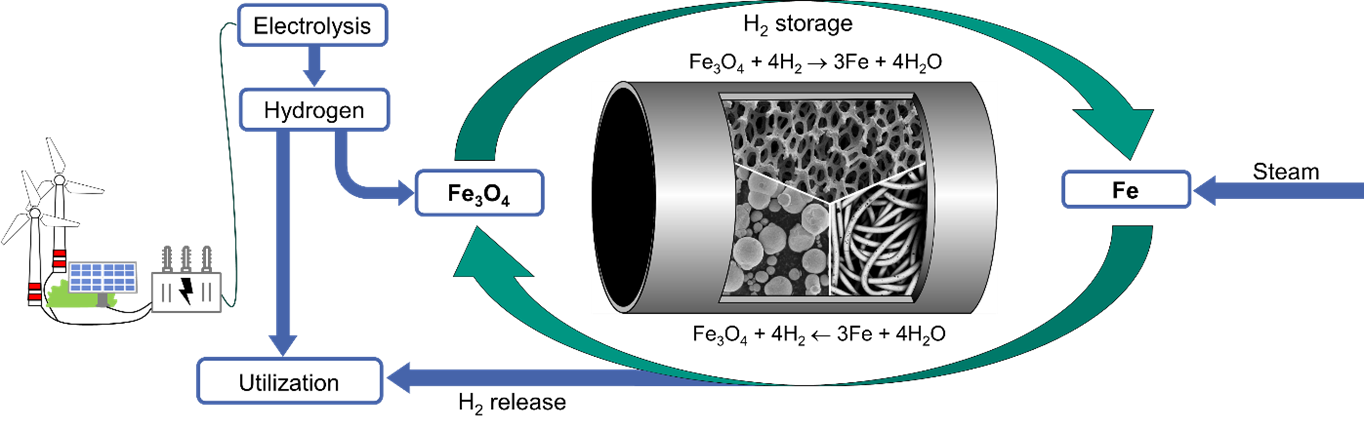
Figure 1. Cyclic process of indirect hydrogen storage via the iron-steam reaction pathway.
The research project “BOY-200 – Development of a reactor with high cycle stability for indirect hydrogen storage via the iron-steam reaction pathway”, funded by the non-profit Friedrich and Elisabeth Boysen Foundation, this material cycle is being investigated in a fixed-bed reactor system with regard to optimal structural properties, reaction conditions, and material composition The objective of the present project is to develop a loop reactor that will facilitate long-term, stable, repeatable redox cycles, whilst achieving elevated hydrogen yields and reduction levels. The present research builds on the findings of a research project funded by the KIT-Academy for Responsible Research, Teaching, and Innovation (ARRTI).
Studies of iron (oxide) particle systems at the Engler-Bunte-Institute confirm strong temperature dependence of the redox reactions as well as the high reduction degrees and hydrogen yields. However, it has also been demonstrated that repeated cycles lead to structural degradation and increasing sintering. This is accompanied by rising pressure losses and poses a significant challenge for continuous reactor designs. While underlying mechanisms have yet to be fully elucidated, the introduction of transition or noble metals can reduce this degradation and accelerate redox reactions through catalytic effects. Additionally, using porous, macrostructured iron materials improves cycle stability and reduces pressure loss, though hydrogen yields can decrease in certain instances.
In this context, this project focuses on the existing trade-offs between high hydrogen yield, cycle stability, and low pressure drop. To this end, macroscopic iron structures are being investigated in terms of cycle stability, pressure drop, and structural integrity, combined with optimized process parameters. Additionally, the introduction of transition metals is being analyzed to achieve further stabilization and catalytic effects. Based on this work, a loop reactor is being developed, validated, and tested in long-term studies under realistic conditions to demonstrate the efficiency, performance, and technical feasibility of indirect hydrogen storage.