
Textüberschrift
Prof. Dr.-Ing. habil. Horst Büchner
Engler-Bunte-InstitutBereich Verbrennungstechnik
Engler-Bunte-Ring 1
76131 Karlsruhe
eMail: Horst.Buechner∂kit.edu
Telefon: 49 1744108299 (mobile)
Fax: 49(0)721 608 47770

Research focuses
Self-excited flow and combustion instabilities, turbulent premix and diffusion combustion, low-pollutant combustion, pollutant formation, mathematical modeling and calculation of combustion systems, burner design, flame modeling
Main research area
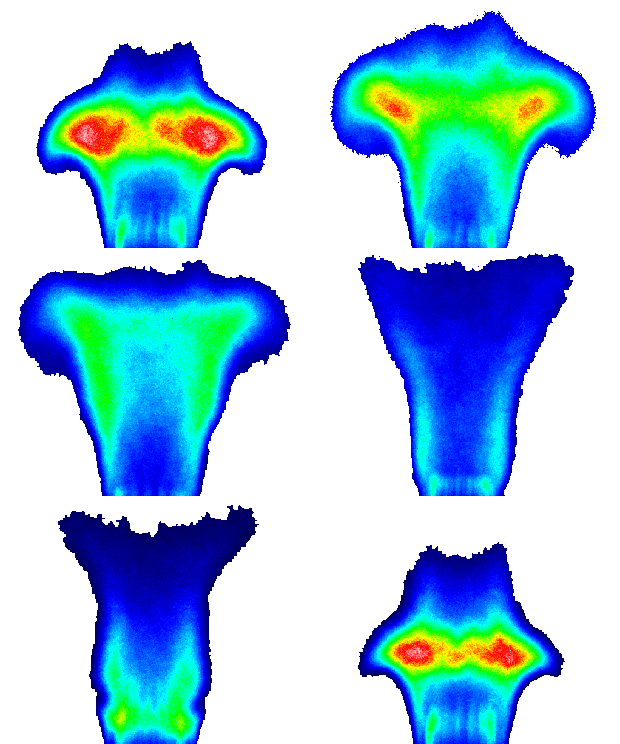
For almost 20 years, the main research area of the research group "Flow and Combustion Instabilities" at the Chair of Combustion Technology has been the investigation and identification of the physical mechanisms that lead to the self-excited development of combustion instabilities ("Thermoacoustics, combustion oscillations, combustion chamber oscillations, pulsating combustion / flames, combustion oscillation" ) in large-scale combustion systems. These periodic disturbances, characterized by high-energy pressure oscillations, lead to strong mechanical and thermal loads on components up to their failure and flashback and are therefore not tolerable for continuous operation of the combustion system. Depending on the underlying feedback mechanism, which of course determines the effectiveness of remedial measures to a considerable extent, both low-frequency vibrations (“rumble, humming”) and high-frequency (“whistling, screaming”) occur, whereby - in addition to the vibration of the static pressure in the combustion chamber as well as in upstream and downstream parts of the system (burner housing, mixing device, exhaust gas routing) - there are also strong fluctuations in the flame geometry and the integral heat release from the combustion process.
The causes for these combustion oscillations, which mostly represent a system instability in which various components of a combustion system (fuel / air mixer, burner, flame, combustion chamber, etc.) interact with one another depending on the time or frequency, which ultimately lead to a considerable , unacceptable amplification causing weak disturbances can be extremely diverse. Periodic fluctuations in the ignition zone (s) ("ignition disturbances"), combustion- or flow-induced changes in the swirl intensities over time ("swirl number, swirl strength, swirl stabilized"), periodic formation of reactive vortex structures ("ring vortex formation, vortex shedding") and their in-phase reaction Excite vibratory overall system in order to then with phase-correct feedback with sufficient energy supply to stable, automatically obtained permanent vibrations at an energetically high level (atmospheric combustion systems often up to 20 mbar pressure amplitudes, pressure-charged combustion systems up to 1 bar at frequencies between a few Hz up to 5 KHz.
The mathematical description of the overall system for calculating its vibration stability requires knowledge of the frequency-dependent transfer behavior ("flame transfer function, amplitude ratio, phase response") of all system components involved in the physical feedback circuit (mixer - burner - flame - combustion chamber), depending on all relevant operating parameters of the furnace ( thermal power, air ratio, type of fuel, swirl strength, mean combustion pressure, etc.), which can be determined using control methods. From these statements, it is then possible to predict the stability behavior of the overall system depending on the geometry and the desired operating ranges, as well as to show effective and inexpensive remedial measures, which must be adapted to the feedback mechanism that is effective in the individual case of vibration. The following graphic is a link to a more detailed explanation of the knowledge we have gained.
further research area
• Investigation of the generation of combustion noise in flames and development of measures to reduce it ("sound pressure measurements")
• Pressure combustion of liquid, pre-evaporated and gaseous fuels in turbulent premixing and diffusion flames
• Calculation and design of resonators as dampers ("damping factor, resonance frequency")
Equipment/test facilities
The following test stands are available to carry out the necessary experimental investigations:
• Large burner test bench up to 2.5 MWth
• Combustion system with air preheating up to 400 ° C for liquid and gaseous fuels up to 300 kWth for diffusion flames and / or premixing
• Test facilities for investigations on small burner systems from 6 kWth to 80 kWth
• Plexiglass chambers for isothermal flow studies
• Pre-evaporator units for LPP operation
• Pulsation units for mass flow modulation that is highly variable and independently adjustable in frequency and amplitude
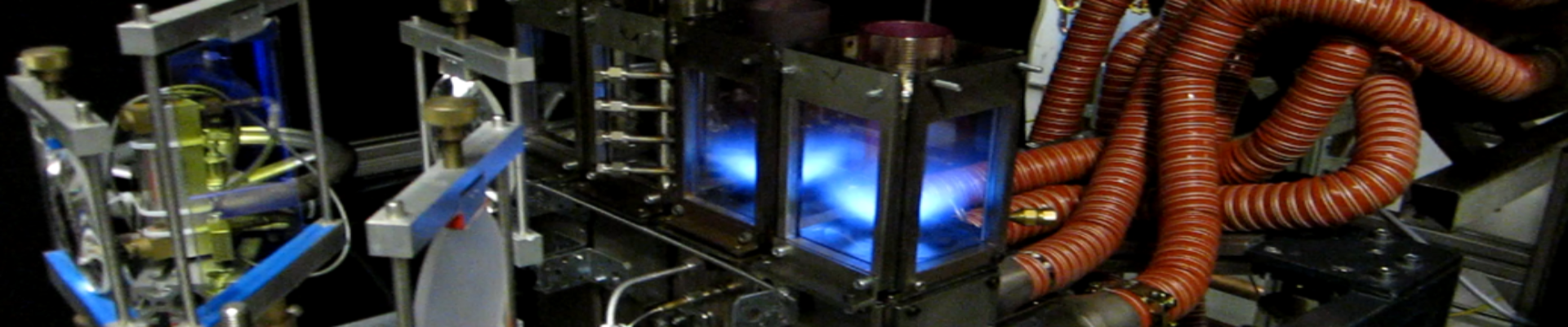
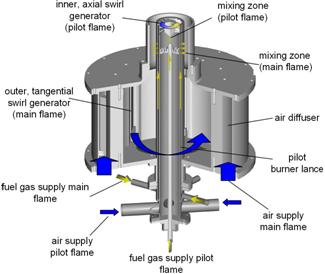
• In-house developed double-concentric, piloted swirl burner with optionally infinitely variable swirl through tangential swirl generator or Axial vane swirl generator with gas turbine-like geometry and infinitely variable outlet configuration (power class 50-500 kWth)
Measurement techniques
In addition to the standard measurement techniques for stationary measured variables in the field of combustion technology / high-temperature process engineering, the following should be emphasized in particular:
• Characterization of isothermal flow instabilities
Constant temperature hot wire anemometry (CTA) and phase-correlated video recordings of the flow field made visible with the help of a tracer medium and a laser light section system
• Detection of rapid changes in the mixture in isothermal, non-reacting flows
In-house development of a high-resolution concentration measurement technology in terms of time and space
• Temporally high-resolution temperature measurement technology
- Fast, electronically inertia-compensated thermocouple measurement technology
- 2-dimensional field distribution of the temperature via Rayleigh scattering
• Reaction conversion behavior of periodically unsteady turbulent swirl and jet flames
- Triggered recordings of the "frozen" overall flame, the flame contour at different points in time within the period of the oscillation by means of a CCD video camera
- Determination of the radiation intensity of excited OH * radicals by photomultiplier
- Planar, laser-induced predissociation fluorescence (2-D PLIPF) of the OH molecules
• Fluctuations in the static pressure of the gas column in the combustion chamber
Cooled condenser microphones with high amplitude resolutions and linear frequency response
• Evaluation of time or frequency dependent signals
2-channel frequency analyzers using correlation methods
Industrial cooperation partner
In the course of the past two decades, undesirable, self-excited pressure / flame oscillations, which have occurred in large industrial plants described below, have been successfully, quickly and inexpensively eliminated within numerous collaborations with industrial companies.
• Electricity generating industry (GuD- power plants)
• Thermal power stations
• Paper industry
• Manufacturer of industrial and household burners
• Reactors from the chemical industry
Lectures and other courses
"Flow and combustion instabilities in technical combustion systems"
In addition to compliance with the pollutant emission limit values prescribed by the legislator, the reliable guarantee of a stable combustion process over the entire control range is one of the greatest problems in the development and optimization of new combustion systems. Combustion chambers that can be coupled during the design phase cause periodic combustion instabilities to be eliminated through empirical measures during commissioning, which are time-consuming and costly modifications to the original design.
• Classification and description of combustion instabilities
Phenomenology, definition of the concept of stability, classification of periodic unsteady combustion processes, influencing variables on the tendency to vibrate
• Metrological recording of dynamic flame properties Hot wire anemometry (flow measurement technology), thermal conductivity probe (concentration measurement technology), inertia-compensated thermocouples (temperature measurement technology), water-cooled condenser microphones (pressure measurement technology), ionization probes (measurement technology for flame front detection), photomultiplier (measurement technology for determining the unsteady reaction behavior using OH radical radiation (Chemiluminescence)
• Properties of turbulent premix flames
• Significance of premixed combustion systems, ignition stability and tendency to oscillation, properties of stationary, turbulent premixed flames, properties of periodically unsteady, turbulent jets and flames (frequency-dependent transmission behavior of premixed, turbulent jet and swirl flames), formation and reaction of turbulent ring vortex structures
• Influence of pressure / flame oscillations on the pollutant emission behavior of the furnace
• Effects of pressure fluctuations on the formation of the fuel gas / air mixture (burnout behavior, thermal NOx)
• Determination of the pressure transfer behavior of a model combustion chamber
• Mathematical description of the resonance behavior of a combustion chamber (Helmholtz resonator model), experimental determination of characteristic combustion chamber properties, temperature and geometry dependency of the vibration damping
• Stability analysis of a simplified premix combustion system
• Examples of self-excited pressure oscillations, stability criteria (e.g. Rayleigh criterion), coupling of the frequency-dependent transmission behavior of burner, flame and combustion chamber, design options for avoiding / suppressing self-excited pressure / flame oscillations (active control and our own processes)
„Energy Technology“
• General aspects of energy technology:
- Importance of energy conversion processes
- Energy supply and energy supplies
- Electricity industry in Germany
- Questions of energy technology
• Thermodynamic basics for the description of energy conversion processes and energy technology issues:
- System term and thermal state variables
- Work, internal energy and warmth - 1st law
- Changes in the state of an ideal gas in open and closed systems, cycle processes
- Irreversible processes and their assessment
- Evaluation of energy conversion processes
• Selected energy conversion processes of thermal power machines and systems:
- Hot gas and internal combustion engines
- Gas turbine
- Steam power plants
- Emission Reduction Technologies
Publications
Bender, C.; Büchner, H.
2009. Acta Acustica united with Acustica, 95 (7), 402–408. doi:10.3813/AAA.918164
Bender, C.; Zhang, F.; Habisreuther, P.; Büchner, H.; Bockhorn, H.
2009. Combustion Noise. Ed.: A. Schwarz, 33–62, Springer-Verlag. doi:10.1007/978-3-642-02038-4_2